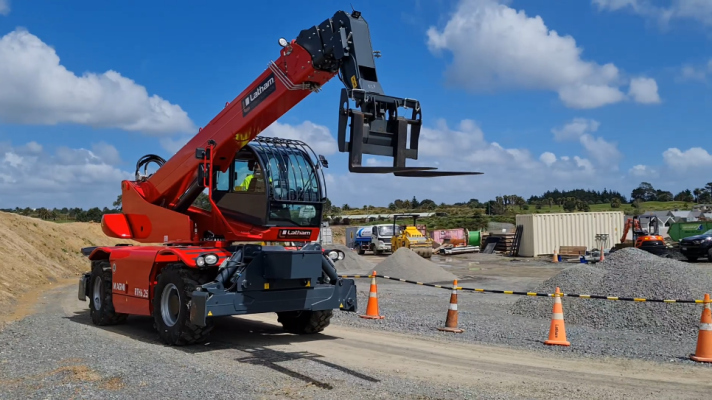
Rotating telehandlers and Franna cranes often get measured against each other, but they were designed to solve different problems. A Franna is a dedicated pick-and-carry crane built for lifting and carrying super heavy suspended loads. A rotating telehandler is a multi-purpose materials handler that can also lift on a hook. They overlap in the middle — moderate loads at moderate height — which is exactly where the comparison gets interesting.
This is a straight, side-by-side look at the two: what each does, where each is strongest, and how operators actually use them. There’s no single right answer, only the machine that fits the work in front of you.
What is a Franna crane?
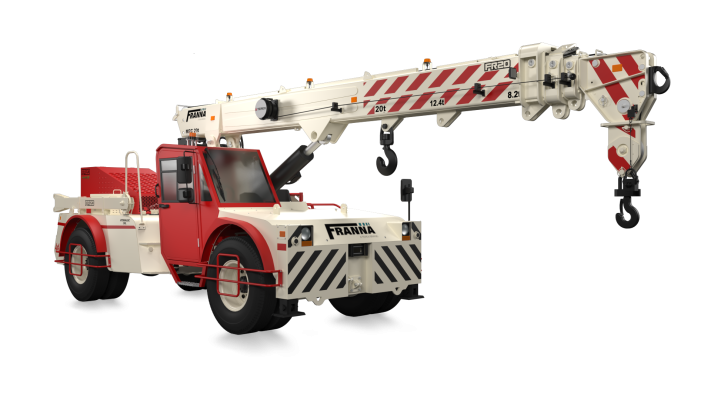
A Franna is an articulated pick-and-carry crane. (“Franna” is the brand — a Terex-owned name — that’s become the generic Australasian term for the type.) Its defining feature is that the machine itself acts as the counterweight, so it can keep moving with a load on the hook. Travel with a load is at a crawl (around 1.5 km/h). It does one job extremely well: lift a super heavy suspended load and shift it around site.
What is a rotating telehandler?
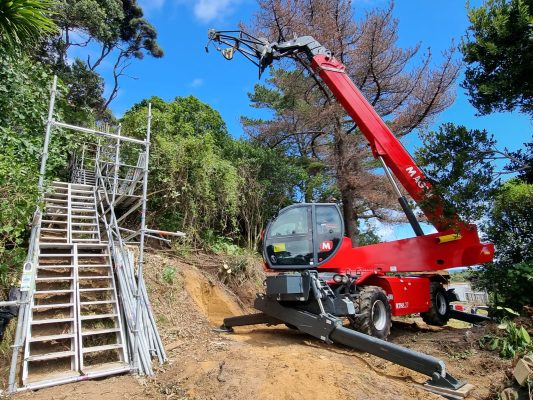
A rotating telehandler is a materials handler with a 360° rotating turret and a telescopic boom. A quick-attach system lets one machine run forks, a jib and hook, a work-platform basket, a bucket or a winch. Crucially, it can pick and carry a load on the move and then set its stabilisers down and lift like a mobile crane — so a single machine does both jobs. It trades a dedicated crane’s raw lifting capacity for reach, height and versatility.
Rotating telehandler vs Franna crane: at a glance
| Franna (pick & carry crane) | Rotating telehandler | |
|---|---|---|
| Primary function | Crane only — suspended loads | Multi-tool: forks, crane, work platform, bucket, winch |
| Max capacity | Very high (e.g. Terex AT40: 40 t at 1.1 m, 35 t at 2 m) | Lower — typically 4–8 t |
| Capacity once turning | Derates with steer/articulation angle and ground slope | Chart varies by reach, height and rotation zone |
| Slew / working arc | Lifts over the front; full chart only within ~10° of straight ahead, derates out to ~40° each side (≈90° arc), then can’t slew | Full 360° slew from a fixed stabilised footprint |
| Max height | ~19 m hook height | 18 m up to ~51 m on the largest models |
| Reach | Limited — short boom, designed for low picks | Strong forward and horizontal outreach |
| Pick & carry | Core strength — keeps moving with the load (at a crawl, ~1.5 km/h) without re-rigging; ~75 km/h only when unladen | Yes — with hook, forks or winch attachments |
| Setup | None — drive and lift | Stabilise for full chart (fast, but not zero) |
| Crane-style lifting | It is a crane | Yes — stabilise and slew 360° like a small mobile crane |
| Size & manoeuvrability | Larger; wide turning circle; best on firm, level ground | More compact; tighter turning circle; 4WD, crab steer, diff locks — strong off-road |
| Attachments | Hook only — can’t take other tools | Full ecosystem, often with RFID auto load-chart recognition |
| Effectively replaces | A small mobile crane | A crane + telehandler + work platform + loader, in one |
Capacity: where the Franna leads
For heavy picks at low-to-mid height, the Franna is in a class the rotating telehandler can’t reach. A Terex Franna AT40 lifts 40 tonnes at a 1.1 m radius and 35 tonnes at 2 m, while rotating telehandlers typically top out around 6–8 tonnes. If the work is genuinely heavy — heavy precast, structural steel marshalling, support-crane duty alongside larger cranes — that capacity is decisive.
It’s worth being clear about how a telehandler’s capacity falls away as it reaches out, because the headline figure is only the start of the story. Take a mid-range machine like the RTH 6.26 — a 26 m rotating telehandler rated at 6 tonnes. Out at a 15 m radius it will lift around 2 tonnes, and at 20 m around 1 tonne. That’s the trade-off for reach and height: the further out (and higher) you work, the less you lift.
The same caveat applies on both sides: rated capacity is always quoted under ideal conditions. A Franna’s headline figures are rated straight ahead, on level ground, at a tight radius — increase the steer (articulation) angle, add ground slope, or extend the boom and the safe working load reduces, often sharply. A rotating telehandler’s chart likewise changes with reach, height and which rotation zone it’s working in. In both cases, the number you actually work to is usually well below the brochure figure.
Slewing: 360° versus a limited arc
This is a difference that catches people out. A rotating telehandler slews a full 360° from its stabilised footprint, so it can pick a load on one side and place it anywhere around the machine without moving. A Franna can’t slew like that — it lifts over the front of the machine. Its load chart is rated for full capacity only within about 10° either side of straight ahead, then derates out to roughly 40° each side (a working arc of around 90°), and that’s the limit. To swing a load through a wider angle, the whole machine has to articulate and reposition. On a congested site, being able to slew right around from one stabilised position is a genuine practical advantage.
Height and reach: where the rotating telehandler leads
When the job involves height or outreach, the rotating telehandler is the clear choice. A Franna’s hook tops out around 19 m at a short radius, whereas rotating telehandlers reach from 18 m up to 51 m on the largest models, with strong horizontal outreach. The current flagship, the Magni RTH 8.51, lifts 8 tonnes to a 51 m working height — performance that starts to overlap with a compact all-terrain crane while keeping interchangeable attachments. Roofing, cladding and steel erection at height are simply outside a Franna’s envelope.
Versatility: one machine that does both jobs
This is the rotating telehandler’s single biggest advantage, and it’s easy to miss if you only compare lift charts. A rotating telehandler can pick and carry a load like a telehandler, then put its stabilisers down and lift like a mobile crane — the same machine, on the same job, minutes apart. It can fork pallets off the truck first thing, slew and place steel on the hook at midday, and put two workers up in a basket to finish. One machine covers work that would otherwise call for a telehandler, a crane, a work platform and a loader.
From a builder’s point of view that’s the real story. Fewer machines to hire, float, insure and certify; no waiting on a crane to turn up for a single lift; and far higher utilisation of the one machine already on site. A Franna, by contrast, is a single-purpose machine — it only takes a hook, so it lifts, and that’s its job. The trade-off for the telehandler’s breadth is a wider operating and competency requirement (more on that below).
Manoeuvrability and off-road performance
On a tight or unfinished site, the rotating telehandler is usually the more practical machine. It’s more compact than a Franna of comparable capability and has a tighter turning circle, so it gets into spots a larger pick-and-carry crane can’t reach. Most models are genuinely capable off-road — four-wheel drive, four-wheel and crab steer, diff locks and good ground clearance let them work in mud and over rough, uneven ground that bogs down a road-biased machine. A Franna is bigger, has a large turning circle and is happiest on firm, level standing; once the ground gets soft, broken or simply tight, the telehandler’s advantage widens.
How operators actually use each machine
In practice, many crews that own a pick-and-carry crane use it for far lighter work than its rating suggests — carrying loads of a few tonnes across a yard, moving materials between work fronts, the occasional beam lifted into place. The high capacity is there for the heavy days, even when those days are infrequent. This is the genuine overlap zone: moderate loads, moderate height, intermittent suspended lifts. A useful way to frame your own decision is to look at what the majority of your lifting actually weighs and how high it goes, rather than the heaviest single lift you might face. If most of the work is light pick-and-carry, a rotating telehandler covers it and adds reach and access; if the heavy lifts are frequent and the loads are large, the Franna is hard to beat.
On-road and site movement
A Franna is registrable and can drive itself between jobs at up to about 75–80 km/h when unladen. The distinction worth understanding is between travelling and carrying: on the road, empty, it moves at vehicle speed, but with a load on the hook it travels at a crawl (around 1.5 km/h). The value isn’t speed under load — it’s that it can keep moving with the load at all, without setting down and re-rigging between picks. A rotating telehandler is usually transported between sites, though once on site its rotating turret and stabilised footprint can reduce the need to reposition repeatedly on confined jobs.
Certification in New Zealand
Both machines carry competency requirements, and they differ. A Franna needs a certified crane operator. A rotating telehandler operator needs NZQA Unit Standard 33426 (operate a rotating telehandler with attachments), a correct driver-licence class for the machine’s weight and a W (wheels) endorsement for on-road use. Because a rotating boom fitted with a hook, jib or winch is treated as a crane, slinging competency is also required — typically US 30072 (slinging regular loads) and US 3789 (slinging varied loads and directing the operator when using a winch) — plus work-platform training when the machine is used for access, and US 31245 (planning lifting operations with mobile plant) for more complex lifts. The telehandler’s versatility comes with a wider training requirement, which is worth factoring into any comparison. (See our telehandler licensing guide for the full picture.)
Which one should you choose?
Choose the Franna when the work is heavy, lift-only, and involves repeatedly picking up and shifting suspended loads around a site without re-rigging. Choose a rotating telehandler when the work involves height, reach, a mix of tasks, or difficult ground — or when you want one machine that can pick and carry, lift like a crane and provide access rather than running several single-purpose machines. The most useful way to decide isn’t to compare top-line lift charts; it’s to picture a real day on your site and ask which machine keeps working through all of it. Many operations have a place for both — the right call comes down to your specific job mix, how heavy and how high you lift, and how often.
Frequently asked questions
What is the main difference between a rotating telehandler and a Franna crane? A Franna is a dedicated pick-and-carry crane built to lift heavy suspended loads and shift them around a site without re-rigging (it travels under load at a crawl, not at road speed). A rotating telehandler is a multi-purpose machine with a 360° turret that lifts, forks, and provides access at greater height, but at lower lifting capacity.
Can a rotating telehandler replace a Franna crane? For lighter lifting and pick-and-carry work at moderate loads, often yes — it can pick and carry like a telehandler and then lift like a crane from its stabilisers, so one machine does both, and it adds height, reach and multiple functions. For heavy lifts (above roughly 8 tonnes), a Franna’s much higher capacity is hard to replace.
Can a rotating telehandler be used as a mobile crane? Yes. With stabilisers deployed and a hook, jib or winch fitted, a rotating telehandler lifts from a fixed footprint with the boom slewing 360°, much like a small mobile crane — and it can also pick and carry, fork and provide access, which a crane cannot.
Can a Franna slew like a crane? No. A Franna lifts over the front of the machine and is rated for full capacity only within about 10° of straight ahead, derating out to roughly 40° each side (about a 90° working arc) before that’s the limit. To reposition a load it has to articulate and drive. A rotating telehandler slews a full 360° from a fixed stabilised footprint.
Which lifts more, a Franna or a rotating telehandler? A Franna lifts substantially more — a Terex AT40 lifts up to 40 tonnes, while most rotating telehandlers top out around 6–8 tonnes. The telehandler wins on height and reach rather than raw capacity.
Which can work higher? The rotating telehandler. Its boom reaches from around 18 m up to roughly 51 m on the largest models, well beyond a Franna’s ~19 m hook height.
Do you need a crane licence for a rotating telehandler in New Zealand? A rotating telehandler operator needs NZQA Unit Standard 33426, the correct driver-licence class and a W endorsement for on-road use. When the machine is fitted with a hook, jib or winch it is treated as a crane, so slinging competency (such as US 30072 / 3789) is also required, plus work-platform training for access work.
Still weighing up which machine suits your work? The APS Equipment team is happy to talk it through.